
The thrilling account of Dracula inspired vampire Anno Dracula
In this last in the series of four blog posts, I finally come to my favourite gothic novel, the first one I read and the one that would come with me to the dessert island should I ever be asked to choose… Bram Stoker’s ‘Dracula’. And in a change to the previous posts, my modern pick also features the vampire, but more of him later…

Dracula
Bram Stoker’s 1897 novel was not the first vampire story to be published in the west (remember John Polidori’s ‘The Vampyre’, referred to earlier in this series?), but it is the one that establishes most of the vampire tropes we are familiar with today (thanks not just to the book, but the many films and theatre plays it has spawned).
Dracula scholars believe that during 1800's Bram read somewhere about the story of a cruel Voivode (semi-independent ruler of Transylvania) who ruled Wallachia between 1448 and 1476 three times. He was Vlad III aka Vlad the Impaler.
The story is told in epistolary form, using letters, journals, ship’s logs and newspaper cuttings to spin the yarn.
Extract: taken from Bram Stoker’s novel, Dracula, written in 1897
In a nutshell
Jonathan Harker travels to the Carpathian Mountains to do some work for Count Dracula, who wishes to buy some property and settle in London. He soon realises that he is Dracula’s prisoner and that the Count is a vampire.
Dracula moves to London via Whitby, where he turns Lucy Westenra into a vampire, despite the best efforts of Arthur Holmwood, Quincy Morris, Dr Seward and Abraham Van Helsing. Lucy is eventually killed by the four and her best friend, Mina Harker is reunited and married to her fiance, Jonathan. Mina and Jonathan join the fight against the vampire.
Mina is turned by Dracula and the men use her to track him back to his castle where he is defeated and Mina is freed. Stoker’s novel was extremely well-researched and was lapped up by his Victorian readers who were, by now, well-used to such horror stories and invasion literature. He is particularly interested in not just the modern technology around him in the latter years of the 19th century, but also in the power that old knowledge has, if Van Helsing was ignorant of vampiric lore the group who move against Dracula would not have been any match for him.
The VampireA fool there was and he made his prayer(Even as you and I!)To a rag and a bone and a hank of hair(We called her the woman who did not care),But the fool he called her his lady fair(Even as you and I!)Oh the years we waste and the tears we wasteAnd the work of our head and hand,Belong to the woman who did not know(And now we know that she never could know)And did not understand.A fool there was and his goods he spent(Even as you and I!)Honor and faith and a sure intentBut a fool must follow his natural bent(And it wasn't the least what the lady meant),(Even as you and I!)Oh the toil we lost and the spoil we lostAnd the excellent things we planned,Belong to the woman who didn't know why(And now we know she never knew why)And did not understand.The fool we stripped to his foolish hide(Even as you and I!)Which she might have seen when she threw him aside --(But it isn't on record the lady tried)So some of him lived but the most of him died --(Even as you and I!)And it isn't the shame and it isn't the blameThat stings like a white hot brand.It's coming to know that she never knew why(Seeing at last she could never know why)And never could understand.Rudyard Kipling (1865-1936)
Anno Dracula
Kim Newman’s 1992 novel is the first in a series of novels, novellas and short stories that start from the premise that Dracula was undefeated at the end of Bram Stoker’s story.

Anno Dracula (1888)
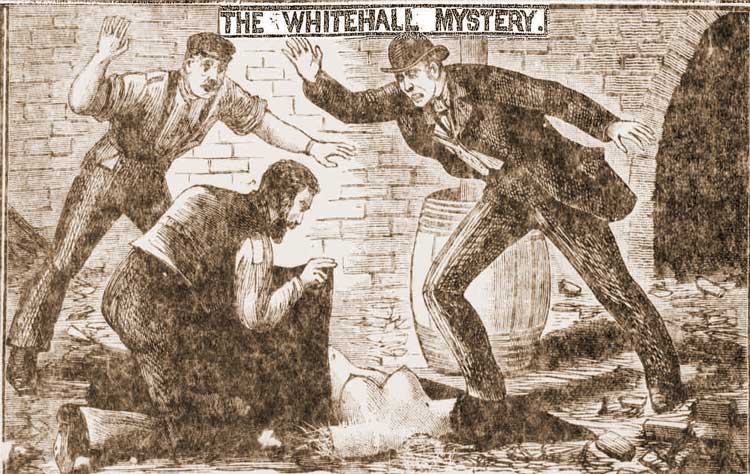
By 1888, Dracula has married the widowed Queen Victoria, and rules as Prince Consort. Many notable fictional vampires have come out of hiding and gained new social status. But all is not going smoothly for the new regime: Jack the Ripper stalks Whitechapel, murdering vampire prostitutes. Charles Beauregard, a (non-vampire) agent of the Diogenes Club, is sent to track the murderer down, and finds himself enmeshed in a plot to free England from Dracula's rule.Unusually for the series, several of the borrowed characters in Anno Dracula have no links to the period. To give just two examples: the heroine Geneviève Dieudonné is recycled from Newman's own Warhammer novels (first appearing in 1989 Drachenfels, written under the name Jack Yeovil), and Carl Kolchak has a brief cameo as a reporter following the Ripper case. (Newman has said that if he had realised he would get so many sequels out of the premise, he would have saved Kolchak up for a story set in the character's native 1970s.)
In a nutshell
The book is very much an alternative history story, setting the scene for the tales that follow.
Dracula, who did not die, remains in London and marries the widowed Queen Victoria, putting him at the very pinnacle of British society.
Vampires are living openly in society and are taking over all the higher echelons, people who want to get on are choosing to become vampires to promote themselves. In Newman’s world there are many varieties of vampire, depending on whose bloodline you are turned by, so all the vampire lines have different characteristics. This enables Newman to bring in many eastern and western vampire tropes through the stories.
In ‘Anno Dracula’, the story revolves around the hunt for Jack The Ripper, who is killing vampire prostitutes. The Diogenes Club sends its best agents (human and vampire), to discover and stop the murderer, and ultimately to try and stop Dracula by any means necessary. There is a death at the end that does stop the Count in his tracks, but he lives to fight another day.
Newman’s story uses characters from history and fiction to people his world. In later stories, he is careful to make sure that all his characters (real and fictional), are of the period he is writing about. The stories mix political satire, popular culture, gothic horror and alternative history.
The story is wide-ranging and well-paced, and it’s great fun to recognise all the historical and literary characters and scenes Newman uses. This is just the first story, with subsequent novels, novellas and short stories bringing Dracula well into the 20th century. He effectively uses many different vampires and vampire tropes in his stories, but they sit together to form a coherent vampire universe alongside humans and other mythical and magical beings.
Why pair these books?
Simply because Newman takes Stoker’s character and moves him on through the years, taking in so many of the seminal moments in history and popular culture and re-framing them in a vampire-led alternative history.
.jpg)
In the end…
That concludes my four post look at 19th century gothic horror and some of the 20th and 21st century stories that keeps this wonderful genre alive. All the books aim to shine a light on humanity, but also shout loudly for the power of knowledge and the consequences of using that knowledge for good or evil. I have so enjoyed re-visiting these books and finding connections and themes within then, I hope I’ve inspired you to visit them too.
Meet this weeks writer Sarah Davies

I’m a writer, storyteller, poet and performer. If I’m really honest, my ideal reader/audience is me, I write what I want to read, and am just really grateful when other people enjoy it too.
I’m a reader as well, I make time every day to read something and often have three or four books on the go at a time.
When I’m not doing word-related things, I spend time in my garden, poking around at the crops I hope will grow, or I’m out running (very slowly), around my neighbourhood.
I was thrilled to be able to re-read and then write about gothic fiction, because it really is one of my favourite genres.
No comments:
Post a Comment