
Why the metaphysical poets matter by Cavan Woods

Metaphysical poetry is a form that sought to explore faith and love. It was especially popular in the 17th century. Despite it being about two key human experiences, it has its critics. For example, Dr Johnson wrote:
“The most heterogeneous ideas are yoked by violence together; nature and art are ransacked for illustrations, comparisons, and allusions; their learning instructs and their subtlety surprises; but the reader commonly thinks his improvement dearly bought, and, though he sometimes admires, is seldom pleased.”
Johnson was shocked by the images they used and thought that they were too clever for their own good. It is a criticism that would be made of T.S. Eliot three centuries later, who saw himself in their tradition, combining their interest in faith and love.
We will examine three metaphysical poets and their work to see what they say to us now. They combine interest in sex, death and God: three great subjects for poems in any era.
George Herbert
George Herbert was born in April 1593, the fifth son of an eminent Welsh family. His mother was a friend of poet John Donne, who dedicated his “Holy Sonnets” to her.

By 1620, Herbert was a Reader in Rhetoric and public orator for the University, a kind of professional spokesman for them. This brought him to the attention of King James the 1st, who granted him an allowance and encouraged him into politics.
In 1624, he was elected the MP for Montgomery, but a year later left the House. He resigned his position at Cambridge University. Yet despite all this, his political career was not the success he wanted. He tried to become a senior adviser to the King, but the King himself suggested that George consider taking his talents elsewhere. Herbert felt a calling to the church. His life was not going to be about seeking power but a life of service.
In 1630, he became priest of Bemerton near Salisbury. While here, he wrote a book about being a parish priest that is still in print today. Three years later, Herbert was dying from tuberculosis. He was just forty by the time he died.
On his deathbed, he asked that his poetry collection called “The Temple” be sent to his friend Nicholas Ferrar. He asked him to publish the poems if he thought “they might help any dejected soul.” Herbert saw his poetry as about inspiring people, not just an art form to entertain himself or others. Ferrar was the leader of a community at Little Gidding in Oxfordshire (This is the Little Gidding that would late give its name to one of T.S. Eliot’s “Four Quartets.”) Herbert’s poems were published and have been in print since.
Herbert often writes poem where he personifies a quality – love or hope for. They can be engaged, argued, accepted and rejected. Herbert’s poems have been given tunes, and then used as hymns or as prayers.
He did play with form – a poem called “Easter wings” celebrates the Resurrection of Jesus by writing it in the formation of butterfly wings. A butterfly is used as an image of the resurrected Christ as it escapes from the “tomb” of the chrysalis. He wrote a poem that looks like a cup to recall the communion. There was both playfulness and purpose in what he was doing: the very shape of a poem could reveal or re-enforce its subject.
Let us look at his poem “Love 3”:

Love III
Love bade me welcome: yet my soul drew back,
Guiltie of dust and sinne,
But quick-ey’d Love, observing me grow slack
From my first entrance in,
Drew nearer to me, sweetly questioning,
If I lack’d any thing.
A guest, I answer’d, worthy to be here:
Love said, You shall be he.
I the unkinde, ungratefull? Ah my deare,
I cannot look on thee.
Love took my hand, and smiling did reply,
Who made the eyes but I?
Truth Lord, but I have marr’d them: let my shame
Go where it doth deserve.
And know you not, says Love, who bore the blame?
My deare, then I will serve.
You must sit down, says Love, and taste my meat:
So I did sit and eat.
The image of Love welcoming Herbert begins as the personification of the idea. Love can overcome that sense of personal moral failure that Herbert expresses at the beginning of the first verse.
Yet it becomes apparent that as the poem progresses, love is the creator God – he made the eyes. Then in the final verse, it is clear that Jesus is the subject – the bearer of blame of sin. The idea of “taste my meat”, of sitting and eating with Love recalls the Last Supper where Jesus offers the bread as his body. It is a beautiful poem, recalling for Herbert the depth of God’s love to him.
The next poem is a contrast: here the poet begins by wrestling with the will of God, feeling trapped by the power of the Almighty.
“The collar” recalls the psalms when the psalmist rails against God. There is a kind of prison, being trapped by following God like forcing a collar on a slave or an animal. The board he strikes is the altar, where communion is celebrated. This is a shocking image to his readers, as it seems like an act of desecration. He is fighting the will of God, seeing it as a kind of slavery until the last few liens where he sees through his raving and hear God call him “Child”, making realised that he is loved by God as a father loves a child. The struggle in the poem reflects the kind of difficulties of the believer with God and recalls in structure a number of Psalms from the Bible.
There is an element here of the kind of spirituality you find in Francis Thompson’s “ The Hound of heaven” – an attraction to God but coupled with a desire to flee, to be free of restriction. Rudolf Otto, the theologian and thinker talked about God as “the numinous”, that which attracts humans and repels them at the same time. God’s holiness is a good thing, but it also makes the believer feel unworthy as they know they can never fulfil this for themselves. Yet when God calls to Herbert, he calls him child, making him realise that religion can be about a loving relationship, not slavery.
Andrew Marvell
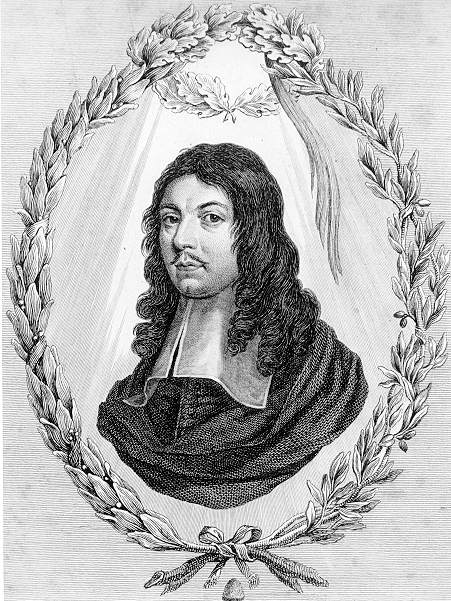
His work is influenced by the Bible and like Donne, he wrote about sex in frank terms. Sex is something to be celebrated, a gift and not a “dirty” thing as some of the more negative approaches of the day argued. It is a gift from God.
Marvell’s poetry is not as overt about his faith as Herbert and Donne. He did not pursue their path into the church but his belief was no less reveal. He uses the images of faith to re-enforce his often very secular poetry.
His most famous poem concerns the reluctance of his beloved to truly commit to him and is a passionate argument to her to act rather than subject him to interminable waiting.
To his coy mistress
Had we but world enough and time,
This coyness, lady, were no crime.
We would sit down, and think which way
To walk, and pass our long love’s day.
Thou by the Indian Ganges’ side
Shouldst rubies find; I by the tide
Of Humber would complain. I would
Love you ten years before the flood,
And you should, if you please, refuse
Till the conversion of the Jews.
My vegetable love should grow
Vaster than empires and more slow;
An hundred years should go to praise
Thine eyes, and on thy forehead gaze;
Two hundred to adore each breast,
But thirty thousand to the rest;
An age at least to every part,
And the last age should show your heart.
For, lady, you deserve this state,
Nor would I love at lower rate.
But at my back I always hear
Time’s wingèd chariot hurrying near;
And yonder all before us lie
Deserts of vast eternity.
Thy beauty shall no more be found;
Nor, in thy marble vault, shall sound
My echoing song; then worms shall try
That long-preserved virginity,
And your quaint honour turn to dust,
And into ashes all my lust;
The grave’s a fine and private place,
But none, I think, do there embrace.
Now therefore, while the youthful hue
Sits on thy skin like morning dew,
And while thy willing soul transpires
At every pore with instant fires,
Now let us sport us while we may,
And now, like amorous birds of prey,
Rather at once our time devour
Than languish in his slow-chapped power.
Let us roll all our strength and all
Our sweetness up into one ball,
And tear our pleasures with rough strife
Through the iron gates of life:
Thus, though we cannot make our sun
Stand still, yet we will make him run.
Marvell begins this poem with a sense of impatience – his mistress; her love is “coy”, slow to respond to his love. They have not “world enough and time” – they are mortal and need to get on with it. She does not have the opportunity to delay to the conversion of the Jews, which the Christians of Marvell’s day would be one of the signs of the Second Coming. “Times winged chariot” is passing quickly: the couple need to act, or else they will be dead. “The grave’s a fine and private place” but you can embrace a corpse. Many lovers have felt the frustrations of Marvell that their loved one is not seeing the urgency of their love and the need to commit. This is a poem that will never date, as it is true to the way the human heart works. Though the imagery might be strange to us, the sentiment is not.

The definition of love
My love is of a birth as rare
As ’tis for object strange and high;
It was begotten by Despair
Upon Impossibility.
Magnanimous Despair alone
Could show me so divine a thing
Where feeble Hope could ne’er have flown,
But vainly flapp’d its tinsel wing.
And yet I quickly might arrive
Where my extended soul is fixt,
But Fate does iron wedges drive,
And always crowds itself betwixt.
For Fate with jealous eye does see
Two perfect loves, nor lets them close;
Their union would her ruin be,
And her tyrannic pow’r depose.
And therefore her decrees of steel
Us as the distant poles have plac’d,
(Though love’s whole world on us doth wheel)
Not by themselves to be embrac’d;
Unless the giddy heaven fall,
And earth some new convulsion tear;
And, us to join, the world should all
Be cramp’d into a planisphere.
As lines, so loves oblique may well
Themselves in every angle greet;
But ours so truly parallel,
Though infinite, can never meet.
Therefore the love which us doth bind,
But Fate so enviously debars,
Is the conjunction of the mind,
And opposition of the stars.
Defining love is not an easy task. It can be influenced by destiny and fate – which are forces that humans do not necessarily have control. It is not always rational. It is the meeting of mind, people realising that they are “truly parallel.” It may make them blind to others. It can overtake what fate might wish. Despite seemingly impossible nature of love, it happens.

John Donne
Born in 1572, John Donne’s father was a merchant and the family were Catholic. This devotion was to cause the family a number of problems. John was an outstandingly gifted scholar who went to Oxford University at 11 and then onto Cambridge. He had to leave there, which he left after he was not allowed to graduate due to his Catholic religion.
He then studied law in London. In the 1590s, he was travelling to places like Spain and Italy, spending his late father’s inheritance on wine and women. He seemed to be the embodiment of a selfish, sensual person but this was to change.
When he was 21, his brother Henry was convicted for his Catholicism and died in prison. This proved to be devastating for his family emotionally. He realised that as long as he was a Catholic, he would find his chances of advancement very difficult.
John distanced himself from the family faith, becoming an Anglican, sufficiently successfully that Sir Thomas Egerton appointed him as a secretary. Egerton was the Great Seal, a senior servant to the King. He, like Herbert, was an influential adviser to people of power. In 1601, Donne became the MP for Blackley.
At 29, Donne fell in love with Anne More who was 16 years old when they married. She was the niece of Sir Thomas More, who had been executed by King Henry the Eighth. This was done in secret in December 1601 which led to him losing his place in Egerton’s service as his patron was appalled by the age difference and the dishonesty that had been required. However, the marriage was declared legal in April 1602.
In 1610, Donne expressed his Protestant faith by writing a defence of King James, saying that Catholics could be loyal to the King and the Pope, arguing it was possible to bring the state and the church in harmony. Increasingly, faith was becoming central to Donne’s life.
It was King James suggested that Donne go into the church, just as he had with George Herbert. In 1615, he was appointed a Royal Chaplain to the King, a sign of the high regard he was held in.
In 1617, disaster struck Donne as his wife Anne died following the death of their twelfth child. Four years later, Donne became the Dean of St Paul’s Cathedral, one of the most senior positions in the church. In 1631, he died aged 59.
His friends decided after his death to publish his poems. Many of them are described as “Holy Sonnets” – a sonnet was normally a form used to express romantic love but Donne took it and turned it to express the depth of his faith.
The poems are about of faith and sex. He had no puritan embarrassment about writing about both. He could find divine presence in prayer and see God’s creative purposes in sex. He wrote with a great deal of wit and style about both. How many people could see the connection between an insect and the act of love? Donne could, as this poem shows:

The Flea
“ The Flea” is an extraordinary frank poem about sex. A flea is a blood sucker – and sex can often involve blood if the new married virgin wife has yet to be penetrated. The marriage bed is a kind of temple: something sacred happens here between husband and wife. Donne is not a dualist who sees something unhealthy or unspiritual in sex – quite the reverse. Sex is something to be embraced.
Death be not proud
Death, be not proud, though some have called thee
Mighty and dreadful, for thou art not so;
For those whom thou think'st thou dost overthrow
Die not, poor Death, nor yet canst thou kill me.
From rest and sleep, which but thy pictures be,
Much pleasure; then from thee much more must flow,
And soonest our best men with thee do go,
Rest of their bones, and soul's delivery.
Thou art slave to fate, chance, kings, and desperate men,
And dost with poison, war, and sickness dwell,
And poppy or charms can make us sleep as well
And better than thy stroke; why swell'st thou then?
One short sleep past, we wake eternally
And death shall be no more; Death, thou shalt die.
Donne’s own life had been marked by a considerable number of bereavements – his wife and five of his children. He could have easily given into despair. Yet here in this poem, he shows that from his Christian faith, death is not a total power and that it needs humility. It is the gateway to awaking eternally in heaven. Death will itself die. This poem is much influenced by 1 Corinthians 15, where Paul writes that “The last enemy to be defeated is death.”
What have the metaphysical poets every done for us?
Herbert, Marvell and Donne were all men who had access to power and found it taken away. They were not destroyed by this but actually; they were able to turn away from personal disappointment to create great art. Had they been successful in the political careers, they would not have had perhaps the time to devote to their poetry. Both Donne and Herbert gave their life in service through the church, where they both found fulfilment that their other lives had not given.
The metaphysical poets have a truth about them which is encouraging to us now. They were able to integrate spirituality and sexuality in a way that many modern believers might be envious. They were able to explore love, both heavenly and earthly in a way that challenges us. They knew that “Time’s winged chariot” demanded that we get on and live in the moment. The struggle to reconcile faith and sexuality is there in the work of Marvin Gaye and Prince. The metaphysical poets show that they do not need to be at war, but are two important aspects of the human story.
Meet our writer Cavan Wood

No comments:
Post a Comment