
Fascination for Frankenstein’s influence
by Sarah Davies
.jpg)
Frankenstein/The Historian
This short series of blog posts looks at four of the seminal works of gothic fiction and pairs them with 20th and 21st century examples of the genre. I have tried to choose modern books that share some kind of theme with their 19th century partner and I hope to inspire you to visit (or indeed revisit), so or all of the works. I have read all eight books I feature in these posts and share them enthusiastically with you, my fellow readers.
For each book I’ll give a brief synopsis of the story, trying hard not to give too many spoilers...
The first pairing I offer is Mary Shelley’s ‘Frankenstein: The Modern Prometheus’ (pub.1818), and ‘The Historian’, Elizabeth Kostova’s 2005 debut novel.

Frankenstein
Heralded as the first science fiction novel, Mary Shelley’s work was conceived on that now infamous Geneva weekend in the summer of 1816, where Lord Byron, Percy Bysshe Shelley, Mary Shelley and John Polidori sat on a stormy night telling ghost stories. Having read a number of stories to each other, Byron suggested that the four should create their own stories. The outcome was Polidori’s novella ‘The Vampyre’ (based on the story that Byron told), and Frankenstein. Mary didn’t tell this story on the night, but thought long and hard about what she could tell and dreamed of a man re-animating a dead being. She later wrote the story we know today.
In a nutshell

The Creature is never named, neither is he the grunting, green, bolt through the neck monster we know from movies. He is a giant, composite creature with dead eyes and a yellowish skin, but he is also intelligent and erudite. It is the reaction of people to his appearance that evokes his rage and causes him to act as he does. Chiefly, he grieves for the fact that his creator disowns and abandons him.
Mary Shelley was fascinated by science and particularly experiments in re-animating dead creatures, this may have been particularly because her mother (the writer and philosopher Mary Wollstonecraft), died giving birth to her, and also Mary’s own experiences of miscarriages and losing her children in infancy. Added to this, Mary had a skin condition (possibly eczema), and was always treated as a sickly child, possibly giving her feelings of monstrousness and alienation that may have influenced the story.
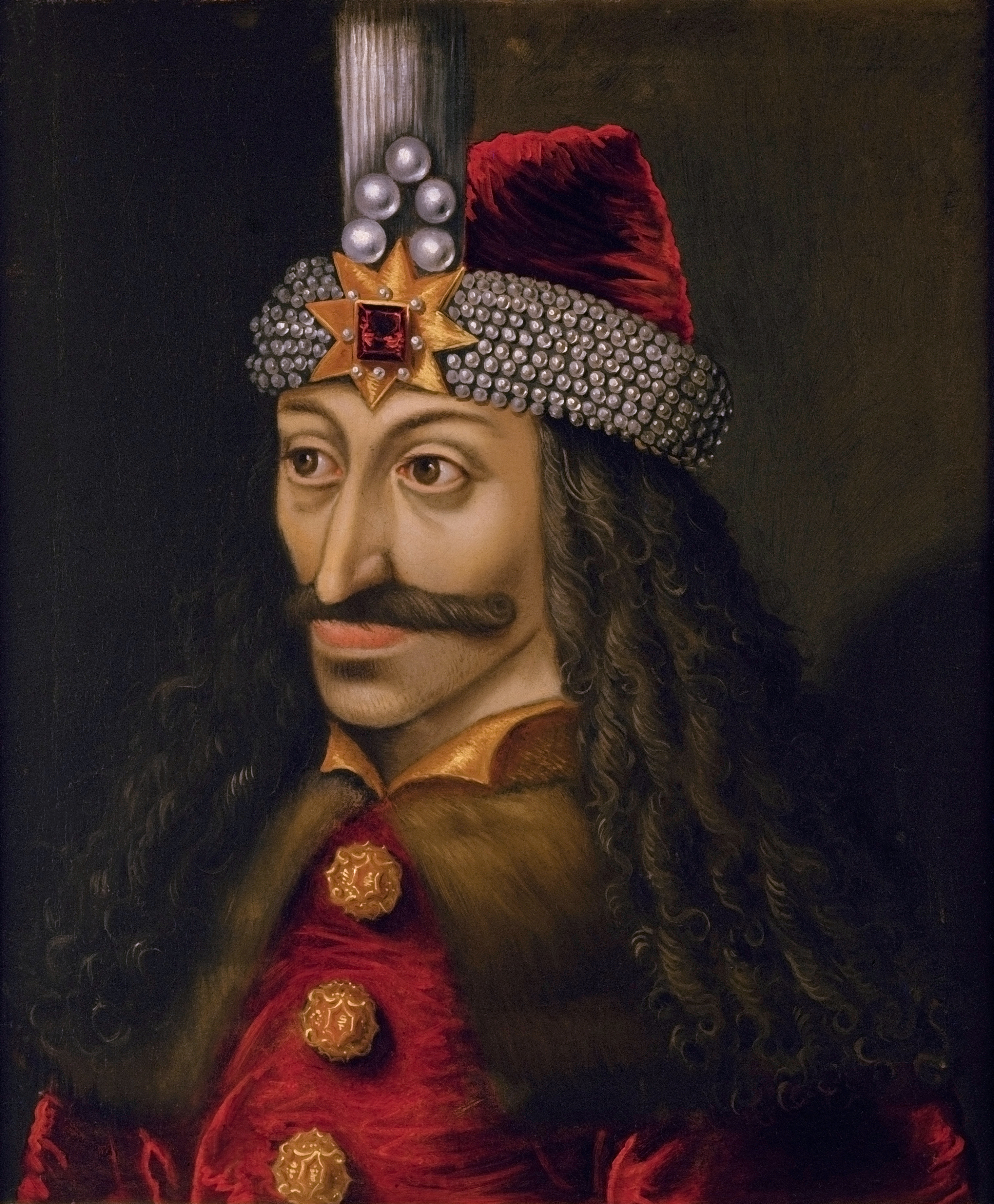
Vlad Tepes
The Historian
Kostova’s book blends the fictional tales of Dracula, with the historical figure Vlad Tepes, and draws heavily on the vampire stories her father told her as she grew up.
In a nutshell
The Historian spans several decades and continents and relies heavily on the libraries and the research skills of Paul and his unnamed daughter as they track Dracula to his tomb. The story weaves eastern and western cultures. A book with a woodcut of a dragon on the cover brings all the searchers to this quest, allowing secret societies and vampires to be introduced to the tale. The book ends with the tantalising possibility that the quest continues…
The Historian is, like Frankenstein, an epistolary tale, drawing on letters and oral accounts to tell the story. It focuses on a love of scholarship and the very clear idea that knowledge is power and enables progress to be made towards to the conclusion of the quest. Other key themes in the book are good and evil and in particular why evil exists and religious conflict, particularly the conflict between eastern and western traditions.
Why pair these books?
It may seem odd at first to put these two books together, but I was struck in both by the importance the authors place on the importance of book. Victor Frankenstein and Paul and his daughter are all learned academics, accessing libraries and books to drive their quests forward. Kostova’s Dracula is also a scholar and librarian, recognising the power knowledge can give him. Frankenstein’s Creature finds a lost satchel of books in the forest, and it is through these that he learns to read, speak and make some sense of the world in which he finds himself.
For Shelley and Kostova, their childhood experiences are instrumental in their conceiving and telling of the stories.
In both Frankenstein and The Historian, much of the horror presented comes not from the characters, but from society, the expectations, presumptions and prejudices of those around the central characters.
Interestingly, both books were also instant hits with readers, but had a mixed bag at the hands of critics.
Both of these books are excellent, if uncomfortable, reads, they will almost certainly fill your dreams during and after reading, but they are excellent stories, well told.
 About Sarah Davies

Writer, Storyteller, Poet, Performer
I’m a writer, storyteller, poet and performer. If I’m really honest, my ideal reader/audience is me, I write what I want to read, and am just really grateful when other people enjoy it too.
I’m a reader as well, I make time every day to read something and often have three or four books on the go at a time.
When I’m not doing word-related things, I spend time in my garden, poking around at the crops I hope will grow, or I’m out running (very slowly), around my neighbourhood.
I was thrilled to be able to re-read and then write about gothic fiction, because it really is one of my favourite genres.
Who would win: Frankenstein's Monster or Dracula book versions?
Malcolm Kogut, Musician
It would be a case of brains versus brawn. If Adam were able to seize upon Vlad, Adam would tear him apart. Wasn’t the last Batman movie based upon this theme where Batman devised plans to incapacitate all Justice League members in case they ever turned? Indeed, Batman’s brains were superior to everyone elses' powers but if any of them were able to get their hands on him, such as Superman, they would tear him apart.
BTW, Adam was not a monster. Read the book and its social commentary. It was a frightened, unenlightened societal mob that monikered him as a monster. He was child-like and a victim of a vengeful society because of a playful accident.
A former pastor of my church got drunk one night, drove home then crashed into and killed a family of five. He went to prison for tenish years for that. Is he a monster or someone who made poor choices? Worse even, are the people who let him leave the party drunk greater “monsters?” Are the real monsters those who with pitchforks and torches in hand that demanded he be punished? Most often, it is the “good” people who are worse because all they want is revenge.
Remember when Squeaky Fromme was released from prison and the town she moved to was this close to digging out the pitchforks and torches. They tried so hard to enforce NIMBY and she only wanted to live out the rest of her life in peace.
There was a story on the news of a bear that ransacked a campsite and even ventured into the lean-to where a family was sleeping. The bear was later euthanised. Bears do what bears do. Rule number one when camping is DON’T SLEEP WITH YOUR FOOD. Who are the monsters? The dumb family, DEC or the bear? If you are afraid of bears, don’t sleep in their woods.
Bill McMahan, Police Captain at Police and Law Enforcement
Original Mary Shelly’s Frankenstein hands down. The original story made Frank’s monster out as a Uber intelligent, super strong, strategically talented, thinking beast. Not the rigid and mostly static monster made popular buy Universal Pictures.
The Monster would recon Drac. Determine his possible weakness or research Van Helsings research on the topic and drive a stake the size of a small tree through Dracula’s coffin and through his heart. This is of course assuming Drac had no knowledge of the impending doom. However if know Vlad had plenty of ways to counter the Monster if he was a known threat, if nothing more being on the constant move to stay far away.
Dracula as portrayed by Stoker is all stealth and devious intelligence.
It would come down to whether Drac could sneak up on the Creature and put him under a mental spell or drain him of blood; we’ll assume that the Creature is human-like enough to have a working circulatory system and the same vulnerability to vampire control.
Shelley’s Frankenstein is perfectly capable of chasing Dracula down as Team Helsing did, I think.
No comments:
Post a Comment